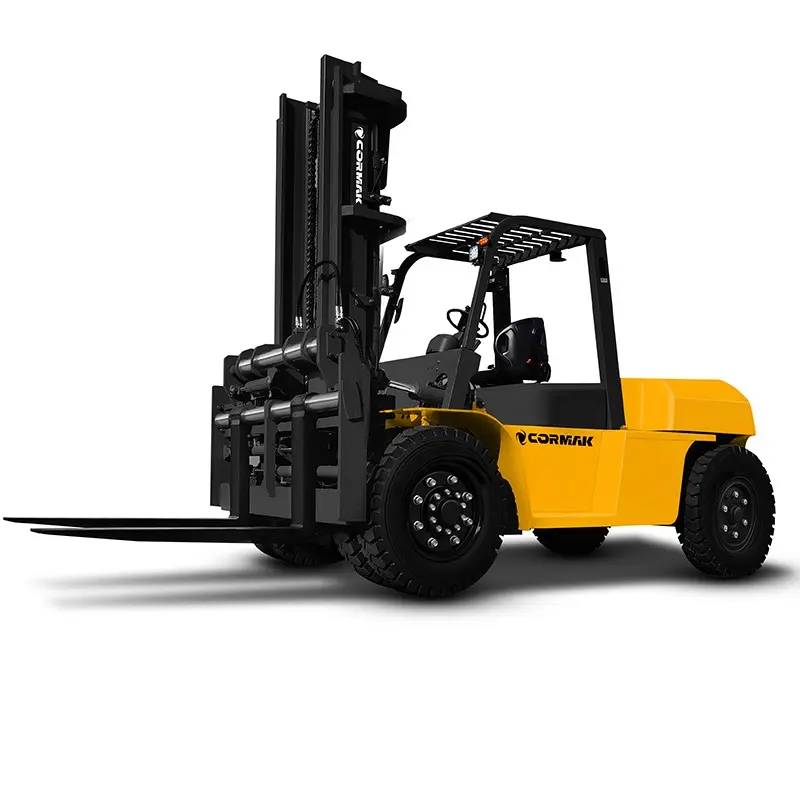
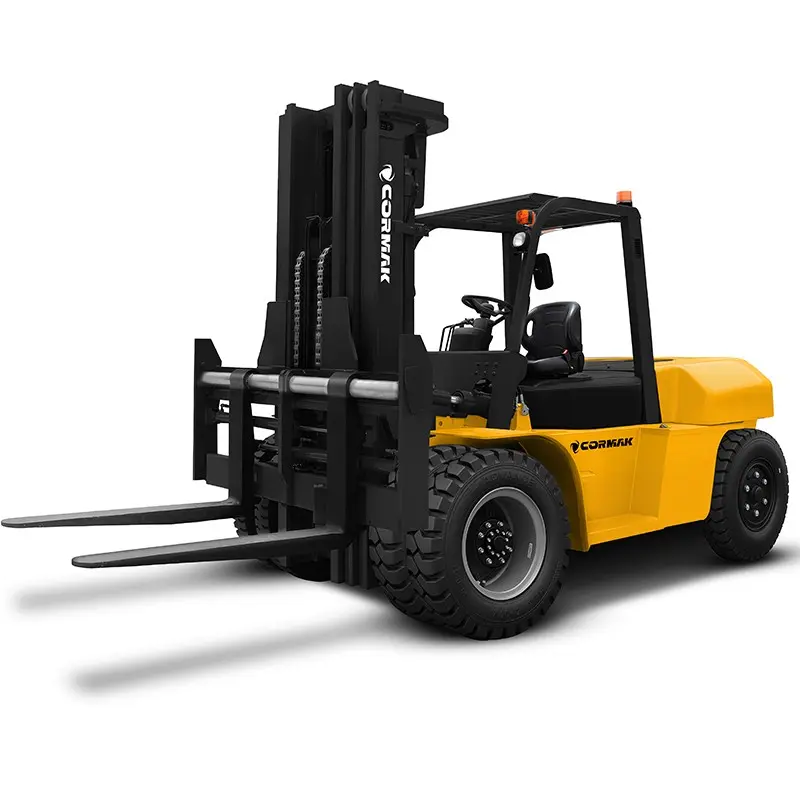
Diesel forklift — 10,000 kg, 3.0 m, DUPLEX
Who it's for and what for
A heavy forklift for work in yards, on ramps and in well-ventilated halls. A 10 t capacity and a 3.0 m DUPLEX mast allow safe handling of steel, prefabricated elements, oversized box pallets and containers. An automatic transmission (Power-Shift), a 110 kW engine and pneumatic tyres increase the smoothness of manoeuvres and comfort on uneven surfaces.
Why this model
- Real load reserve: 10 t for heavy, asymmetric loads (fewer trips).
- A simple, rigid column: DUPLEX 3.0 m – optimal for typical storage heights, lower service costs vs. very high masts.
- Drive performance: Diesel EURO V + automatic transmission = constant torque and smooth direction changes during loading.
- Load control: side shift and mast tilt shorten the time to 'hit' the rack slot/trailer.
- Adapted to the yard: pneumatic tyres better absorb unevenness and reduce the risk of jolting at 10 t.
Applications
- Storage yards, construction sites, metallurgy, prefabricated elements, the timber industry.
- Loading/unloading trucks, working on ramps and travel between the hall and the yard.
- Transport inside large facilities with ensured ventilation (combustion drive).
Duplex vs Triplex
- Duplex (2 sections) – greater rigidity, simpler mechanics; ideal for ~3 m and 'heavy-duty' work.
- Triplex (3 sections) – greater reach (4–5 m) and often free-lift, but greater complexity/weight.
If most operations are ≤ 3 m and the priority is capacity/stability, Duplex is a sensible choice.
What you gain vs LPG / electric
Diesel 10 t vs LPG 2.5–3.5 t: much greater capacity and off-road resistance, at the cost of emissions and noise.
Diesel 10 t vs electric 1.6–2.5 t: no downtime for charging, better work in the yard; electric models win in 'zero-emission' zones.
Selection checklist (10 t)
- Max. weight and centre of gravity of the load (mm) + any attachments (impact on residual capacity).
- Route and surface (yard/paving/inclines) → selection of tyres and gear ratios.
- Working height: if < 3 m – Duplex; if > 3 m – consider alternatives (Triplex, overhead crane).
- Cycles and distances: long journeys/lots of start-stop → cooling, filters, inspection schedule.
- Health & safety: visibility, lighting, Blue/Red Spot, cameras.
- Ventilation: the plant's policy on emissions (EURO V).
- TCO: fuel/tyres/service vs alternative drives.
FAQ (frequently asked questions)
Does the 10 t apply for every fork length?
— No. The capacity depends on the centre of gravity and attachments; extensions/positioner reduce the residual capacity.
Can I work in a hall?
— Yes, provided ventilation is ensured and health & safety rules for combustion drives are met (EURO V).
Does it have side shift and tilt?
— Yes, both elements are in the WS100D30 specification – they help to put down the load quickly and precisely.
What are the working dimensions of the forks?
— Length 1520 mm, min. height 80 mm (easier driving-in and picking up pallets).
What is the power and dead weight?
— 110 kW (149.6 hp) and approx. 9340 kg – this translates into stability and efficient manoeuvres under load.