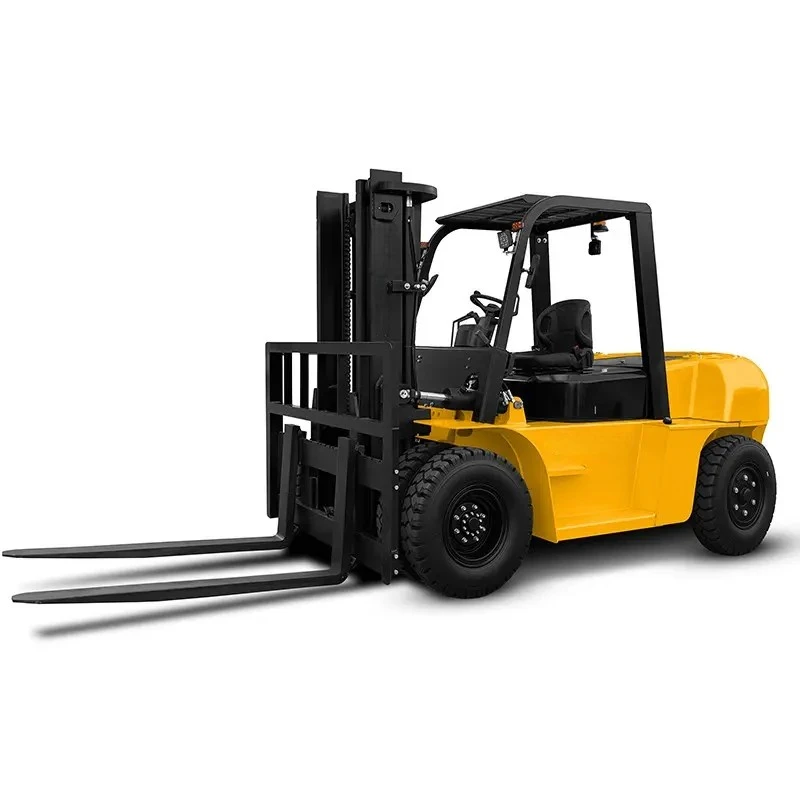
Diesel forklift — 8000 kg, 3000 mm, DUPLEX
Who it's for and what for
The WD1C forklift is a heavy yet surprisingly manoeuvrable 'eight-tonner' for work in yards, on ramps and in well-ventilated halls. A capacity of 8 t and a lifting height of 3.0 m (DUPLEX mast) allow safe handling of steel, prefabricated elements, moulds, large box pallets or IBCs on ISO/EUR pallets. The automatic transmission (Power-Shift) and a powerful 110 kW (149.6 hp) engine ensure smooth manoeuvres under load. A dead weight of approx. 9340 kg ensures the stability of the unit.
Why this model
- Real 8 t performance — a capacity reserve for heavy, non-standard load units.
- DUPLEX 3.0 m — a simple, rigid column for typical storage heights (lower service costs vs. very high masts).
- Diesel drive + Power-Shift — constant torque, fast approaches, smooth direction changes during loading.
- Load control — side shift and tilt shorten the time to 'hit' the rack slot or the truck.
- Tyres — twin pneumatic tyres at the front better absorb the unevenness of the yard and minimise jolting under heavy load.
Applications
- Storage yards, heavy production, construction, metallurgy, prefabricated elements, the timber industry.
- Loading/unloading trailers, handling heavy units on ramps and outdoors.
- Internal transport in halls with ensured ventilation and an emissions policy for combustion drives (health & safety requirements).
Selection checklist (8 t)
- The heaviest load (kg) + centre of gravity (mm).
- Route and surface: yard, paving, ramp threshold, inclines → selection of tyres and gear ratios.
- Working height: if <3 m → Duplex; if >3 m → assess Triplex/alternatives for costs and stability.
- Cycle frequency: outdoor journeys, long routes → cooling, filters, inspection schedule.
- Attachments: extensions, fork positioner, clamps; impact on residual capacity.
- Health & safety: visibility, signalling (Blue/Red Spot), cameras, lighting.
- Emissions and ventilation: the plant's policy for combustion drives.
- TCO: fuel/filters/tyres vs. alternative drives.
Frequently asked questions (FAQ)
Is 8 t the capacity for every fork length?
— No. The capacity depends on the load's centre of gravity and attachments. Extensions/positioner reduce the residual capacity.
Can I work inside a hall?
— Yes, as long as you ensure the required ventilation and meet the health & safety requirements for exhaust emissions (diesel). In sensitive zones, consider LPG/electric.
Why do I need twin tyres at the front?
— At 8 t they significantly improve stability and comfort on uneven surfaces; they reduce unit pressures.
Does it have side shift and tilt?
— Yes, the distribution specifications include side shift and tilt — this shortens the time of accurate placement.
What is the engine power?
— About 110 kW (149.6 hp) in this class; with the automatic transmission it ensures smooth manoeuvres under load.
How much does the forklift itself weigh?
— About 9340 kg (dead weight), which translates into the stability of the raised-load system.