
The Use of Display Pallets Can Increase Sales
Published on: 10-06-2021
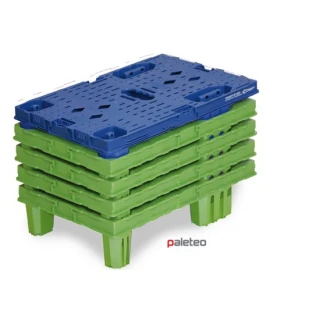
Retailers are constantly looking for new solutions to improve the effectiveness of promotional activities and increase sales. Distribution chains are increasingly using new pallet formats called display pallets to display products. Such pallets have already become standard in discount stores and are increasingly popular in small and large format store chains.
Plastic pallets : see 800x600 pallet models
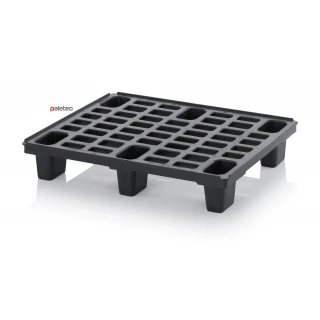
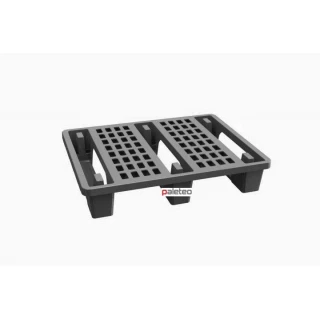
More and more retailers see the potential in the use of display pallets, which are becoming an effective tool for increasing sales. Due to their size (800 x 600 and 600 x 400 mm), these types of pallets are successfully used to display products in the checkout area and in store aisles. Their size allows the use of small space in such a way that the location of the product on the pallet does not impede the movement of customers and does not interfere with shopping. This ensures that the promotion area is maximized and allows better use of store space.
Display pallets also provide greater efficiency and less time-consuming in-store merchandising. In addition, they reduce the cost of warehouse operations (ease of identification and reduction of product lining time in the store) and, as a result, influence increased sales, as products handled with display pallets are better displayed. Another advantage is their ease of movement increasing the possibility of making modifications on the store floor.
The benefits of using display pallets are not only related to product display, which improves product visibility and brand recognition. Display pallets also optimize the store's merchandise supply logistics. The replenishment process is carried out faster, with manual work minimized, which brings significant savings by minimizing costs.
Sales, logistics and marketing departments are facing new challenges with pallets: attracting customer attention to the products displayed on the pallet, meeting environmental requirements, and increasing the functionality of the pallet.
In recent years, the distribution sector has experienced far-reaching transformations. The average buyer views items at a rate of 300 per minute. Considering that nearly 80 percent of purchases are made on impulse, it turns out that aesthetic packaging plays a role similar to that of an advertising investment. Modern distribution requires standardization of systems, operational improvements and the provision of adequate security. In the area of palletizing goods, the answer to market requirements is precisely the display pallet, designed to reduce costs while increasing sales. (source : portalspozywczy.pl)
Other articles
-

24-11-2026 Which parking grid should you choose? Load capacity, dimensions and pieces per m²: table
A parking grid is chosen primarily by the load it has to carry: for foot traffic and gardens, grids with a load capacity of approx. 150 t/m² (2.5–3 cm high) are sufficient; for driveways and car parks for passenger cars – 250–350 t/m² (4 cm high); for heavy traffic and the highest axle loads – 450 t/m² grids or 5 cm high models. Depending on the format, you need 2 to 7 grids per m² – the most popular 50 × 50 cm format means 4 pieces per m².
-

17-11-2026 How much does a pallet weigh? Euro, plastic and H1 pallet weights: table
A wooden EPAL Euro pallet measuring 1200 × 800 mm weighs approximately 25 kg. A plastic pallet of the same size weighs, depending on its design, from approx. 4.5 kg (a lightweight open-deck export pallet) to approx. 20 kg (closed-deck, reinforced). A hygienic H1 pallet 120 × 80 weighs 18 kg, and 120 × 100 plastic pallets weigh from approx. 6.5 to 23 kg.
-

10-11-2026 IBC tank in winter: how to protect an IBC container from frost
In winter, an IBC tank (1000 l IBC tote) must above all be protected against its contents freezing – water expands by about 9% when it turns to ice, which can crack the drain valve and damage the bottle. An IBC used for rainwater is best emptied before the frosts. An IBC holding process liquids should be stored in a heated building or wrapped in a thermal insulation jacket and – at sub-zero temperatures – a heating jacket with a thermostat.