
How much does a pallet weigh? Euro, plastic and H1 pallet weights: table
Published on: 17-11-2026
A wooden EPAL Euro pallet measuring 1200 × 800 mm weighs approximately 25 kg. A plastic pallet of the same size weighs, depending on its design, from approx. 4.5 kg (a lightweight open-deck export pallet) to approx. 20 kg (closed-deck, reinforced). A hygienic H1 pallet 120 × 80 weighs 18 kg, and 120 × 100 plastic pallets weigh from approx. 6.5 to 23 kg.
Pallet weight is a parameter that often only comes to mind when the freight bill arrives or when rack load limits are checked. Yet with several dozen pallets on a trailer or several hundred in internal circulation, a difference of a few kilograms per unit translates into real costs. Below we have compiled the weights of the most popular types of plastic pallets and compared them with the wooden Euro pallet.
What determines the weight of a pallet?
- Size. A 1200 × 1000 mm pallet has approx. 25% more surface area than a 1200 × 800 mm one, so with the same design it is correspondingly heavier.
- Closed or open deck. A closed (smooth) deck uses more plastic than an open (grid) deck. This is the main difference between a pallet of approx. 5 kg and one of approx. 15–18 kg.
- Base: feet, 3 runners, 5 runners. Pallets on feet only (without runners) are the lightest but are not suitable for racking. Runners stiffen the pallet and increase its load capacity, but add a few kilograms.
- Reinforcements. Steel profiles inside the structure, a perimeter lip on the deck edge or anti-slip elements increase the weight, but also the racking load capacity.
- Material. Plastic pallets are most often made of HDPE or PP. A wooden Euro pallet absorbs moisture, so its weight changes over time; a plastic pallet has a constant weight.
Table: how much do 120 × 80 and 120 × 100 pallets weigh
| Pallet type | Size [mm] | Example model | Weight |
|---|---|---|---|
| wooden EPAL Euro pallet | 1200 × 800 | EPAL 1 | approx. 25 kg |
| plastic open-deck, lightweight | 1200 × 800 | PPG5 | approx. 4.5 kg |
| plastic export pallet (on feet) | 1200 × 800 | PPG2 | 5.8 kg |
| plastic open-deck on runners | 1200 × 800 | 1280W | approx. 11 kg |
| plastic closed-deck with perimeter lip | 1200 × 800 | PAR1 | approx. 14.5 kg |
| plastic hygienic pallet | 1200 × 800 | PACZ1 | approx. 15 kg |
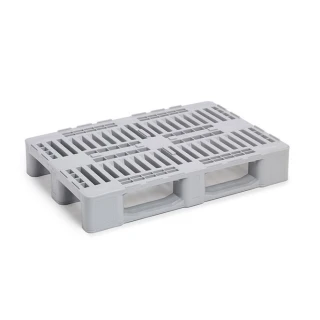
| plastic H1 pallet (GS1) | 1200 × 800 × 160 | H1 | 18 kg |
| plastic smooth deck, no lip | 1200 × 800 | 1280G | 18 kg |
| plastic anti-slip pallet | 1200 × 800 | PPC1A | 19 kg |
| plastic export pallet (on feet) | 1200 × 1000 | 1210L | 6.5 kg |
| plastic open-deck on runners with perimeter lip | 1200 × 1000 | PAL6 | approx. 8.5 kg |
| plastic closed-deck with perimeter lip | 1200 × 1000 | PAR3 | approx. 17 kg |
| plastic hygienic pallet | 1200 × 1000 | PACZ3 | approx. 18 kg |
| plastic black smooth-deck pallet | 1200 × 1000 | 1210G | 21 kg |
| plastic anti-slip pallet | 1200 × 1000 | PPC2A | approx. 23 kg |
Plastic pallet weights according to the product pages in the PALETEO shop; EPAL pallet weight according to the EPAL specification. Values marked “approx.” are approximate weights stated on the product pages.
How much does a Euro pallet weigh?
A standard wooden Euro pallet (EPAL 1) measuring 1200 × 800 × 144 mm weighs approximately 25 kg. This applies to a dry pallet: wood absorbs water, so a pallet stored outdoors can be noticeably heavier. Plastic equivalents of the Euro pallet, i.e. plastic pallets 120x80, weigh from approx. 4.5 kg to approx. 20 kg and do not change weight with moisture.
How much does an H1 pallet weigh?
The hygienic H1 pallet 1200 × 800 × 160 mm made of HDPE weighs 18 kg. It is a pallet with a closed, easy-to-wash deck, used in the food, meat and dairy industries. Other 120 × 80 hygienic plastic pallets have a similar weight (approx. 15–18 kg), and in the 120 × 100 size approx. 18–18.5 kg.
How much does a 120 × 100 plastic pallet weigh?
The lightest plastic pallets 120x100 are export and open-deck models on feet, at approx. 6.5–6.7 kg. Open-deck models on runners weigh approx. 8.5–14 kg, closed-deck and hygienic models approx. 17–18.5 kg, and the heaviest closed-deck, smooth or anti-slip models 21–23 kg (e.g. the black smooth-deck plastic pallet 120x100, 21 kg).
Light or heavy pallet: which to choose?
- Export and one-way shipments: a lightweight open-deck or export pallet (approx. 4.5–6.5 kg). It reduces shipment weight and air freight costs, and plastic pallets do not require ISPM 15 treatment. Example: the plastic export pallet PPG2, 5.8 kg.
- Internal circulation, pallet trucks, conveyors: a medium-weight pallet on runners (approx. 8–15 kg), stable on roller and chain conveyors.
- Racking and heavy loads: a closed-deck pallet on runners, often reinforced (approx. 15–23 kg). Here, higher weight goes hand in hand with higher racking load capacity.
- Food industry: an H1 or hygienic pallet with a closed deck (approx. 15–18 kg), easy to wash and disinfect.
When choosing a pallet, always compare its weight with its static, dynamic and racking load capacity: a light pallet that cannot carry the load on a rack is no saving.
How to calculate the weight of a palletised load?
Gross weight of the unit load = pallet weight + goods weight + weight of packaging and securing materials (stretch film, corner boards, straps). Example: 30 H1 pallets at 18 kg each come to 540 kg of carriers alone, while 30 wooden Euro pallets at approx. 25 kg each come to approx. 750 kg. A difference of approx. 210 kg in a single shipment is payload you can use for goods.
Frequently asked questions (FAQ)
How much does an empty Euro pallet weigh?
A wooden EPAL Euro pallet 1200 × 800 mm weighs approx. 25 kg (dry). A plastic 120 × 80 pallet weighs from approx. 4.5 kg (lightweight open-deck) to approx. 20 kg (closed-deck, reinforced).
How much does a plastic pallet weigh?
It depends on the size and design. 120 × 80 pallets usually weigh 4.5–20 kg, 120 × 100 pallets 6.5–23 kg. Open-deck pallets on feet are the lightest; closed-deck pallets on runners with reinforcements are the heaviest.
How much does an H1 pallet weigh?
An H1 pallet 1200 × 800 × 160 mm made of HDPE weighs 18 kg.
Does a lighter pallet have a lower load capacity?
Usually yes: lightweight open-deck pallets on feet are designed mainly for transport and export, not for storage on racking. The racking load capacity is always stated on the product page.
Is a plastic pallet lighter than a wooden one?
In most cases, yes. Even closed-deck plastic pallets 120 × 80 (approx. 18–20 kg) are lighter than a wooden Euro pallet (approx. 25 kg), and lightweight open-deck pallets weigh several times less.
Match the pallet to your load: ask for a wholesale quote
PALETEO – a brand and supplier of plastic pallets and warehouse equipment. We sell directly and ship from our warehouse in Bydgoszcz, Poland. Looking for pallets with a specific weight and load capacity for export, automation or the food industry? Write to info@paleteo.pl and we will prepare a wholesale quote and help you choose the right model for your load.
Other articles
-

24-11-2026 Which parking grid should you choose? Load capacity, dimensions and pieces per m²: table
A parking grid is chosen primarily by the load it has to carry: for foot traffic and gardens, grids with a load capacity of approx. 150 t/m² (2.5–3 cm high) are sufficient; for driveways and car parks for passenger cars – 250–350 t/m² (4 cm high); for heavy traffic and the highest axle loads – 450 t/m² grids or 5 cm high models. Depending on the format, you need 2 to 7 grids per m² – the most popular 50 × 50 cm format means 4 pieces per m².
-

10-11-2026 IBC tank in winter: how to protect an IBC container from frost
In winter, an IBC tank (1000 l IBC tote) must above all be protected against its contents freezing – water expands by about 9% when it turns to ice, which can crack the drain valve and damage the bottle. An IBC used for rainwater is best emptied before the frosts. An IBC holding process liquids should be stored in a heated building or wrapped in a thermal insulation jacket and – at sub-zero temperatures – a heating jacket with a thermostat.
-

01-07-2026 Pallet boxes in logistics and warehousing. How to choose the right model for your industry?
When we think of transport, the first association is usually the classic wooden Euro pallet. Although its merits are undeniable, there are industries where an “ordinary” pallet is not enough. Where maximum protection of goods, hygiene and space optimisation matter, pallet boxes come into play.