
Which parking grid should you choose? Load capacity, dimensions and pieces per m²: table
Published on: 24-11-2026
A parking grid is chosen primarily by the load it has to carry: for foot traffic and gardens, grids with a load capacity of approx. 150 t/m² (2.5–3 cm high) are sufficient; for driveways and car parks for passenger cars – 250–350 t/m² (4 cm high); for heavy traffic and the highest axle loads – 450 t/m² grids or 5 cm high models. Depending on the format, you need 2 to 7 grids per m² – the most popular 50 × 50 cm format means 4 pieces per m².
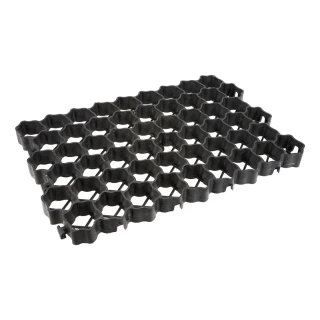
A plastic parking grid (also called a grass grid, grass paver or ground reinforcement grid) stabilises the surface while letting rainwater soak into the ground. The models differ in wall height, wall thickness and format – and this determines the load capacity, the number of pieces per square metre and the cost of the whole project. Below we have collected the specifications of all parking gratings in our range so that you can compare them in a single table.
What determines the load capacity of a parking grid?
- Wall height. The higher the cell (from 2.5 to 5 cm, 10 cm in green roof grids), the better the grid spreads the wheel load and the more infill it holds.
- Wall thickness. From 3 to 5 mm in our models (10 mm in the green roof grid). Thicker walls = higher load capacity and a heavier piece.
- Cell shape and number. A dense honeycomb (49–54 cells per grid) supports the wheel better than a few large cells.
- Sub-base and infill. The load capacity stated on the product pages refers to the grid "without infill". In practice, how much the surface can carry also depends on a properly prepared and compacted sub-base.
It is worth distinguishing between two parameters: load capacity (t/m²) describes the grid itself, while the permissible axle load (in tonnes or kN; 1 t ≈ 9.81 kN) tells you which vehicles can drive on it.
Table: parking grids and grass grids – specifications
| Model | Dimensions [cm] | Height [cm] | Pcs/m² | Weight [kg/pc] | Load capacity* [t/m²] | Axle load | Application |
|---|---|---|---|---|---|---|---|
| KT25G | 41.5 × 41.5 | 2.5 | 6 | 0.7 | 150 | 200 kN | foot traffic, gardens |
| KT3G | 50 × 50 | 3 | 4 | 1.1 | 150 | 140 kN | paths, paddocks |
| KT4G | 50 × 50 | 4 | 4 | 1.4 | 250 | 200 kN | driveways, passenger cars |
| KT40G | 38.5 × 38.5 | 4 | 6–7 | 0.9 | 300 | 240 kN | car parks (passenger cars) |
| KP4G | 60 × 39.5 | 4 | 4.2–4.4 | 1.5 | 350 | 24 t | car parks, access roads |
| KTD40G | 49 × 49 | 4 | 4.2 | 1.7 | 350 | 24 t | car parks (double-sided grid) |
| KP5G | 60 × 39.5 | 5 | 4.2–4.4 | 1.95 | 350 | 24 t | busy car parks |
| KTM4G | 50 × 50 | 4 | 4 | 2.0 | 450 | 360 kN | heavy traffic |
| KTM5G | 50 × 50 | 5 | 4 | 2.3 | 450 | 360 kN | heavy traffic, highest loads |
| KTS60G | 60.5 × 40.5 | 4 | 4 | 0.8 | 100 | 120 kN** | slopes, embankments (anchor pockets) |
| KTD1G | 81 × 61 | 10 | 2 | 7.2 | 300 | 20 t | green roofs, terraces |
Data from the product pages in the PALETEO shop. Load capacity stated for the grid without infill; for the slope grid, the axle load refers to a grid filled with stones.
Which grid for which application?
- Footpaths, cycle paths, gardens, animal paddocks: light 150 t/m² grids (KT25G, KT3G). For foot traffic, the grid can be laid without a sub-base and sown with grass.
- Home driveways, car parks for passenger cars, residential parking spaces: 4 cm high grids with a load capacity of 250–350 t/m² (KT4G, KT40G, KP4G parking grid).
- Busy car parks, access roads, fire access roads: 350 t/m² grids 5 cm high (KP5G) or 450 t/m² models with an axle load of 360 kN (450 t grass grid KTM5G, KTM4G).
- Slopes and embankments: the slope grid KTS60G with large 12 × 12 cm cells and 5 anchor pockets that stabilise it on an incline.
- Green roofs and terraces: the tall (10 cm) green roof grid KTD1G – 2 pieces per m².
How many parking grids per m²? Calculating your order
Number of pieces = area × number of grids per m² (from the table). Add a few percent extra for cutting at edges and curves.
Example: a 100 m² car park made of KP4G grids (4.2–4.4 pcs/m²) requires approx. 420–440 grids. At 1.5 kg per piece, the whole delivery weighs approx. 630–660 kg – important when planning transport and unloading. The same car park made of KTM5G grids (4 pcs/m², 2.3 kg/pc) means 400 pieces and approx. 920 kg.
Infill and installation in brief
The grid cells are filled with soil and grass (grass car parks) or with gravel or grit (gravel car parks). The grids are connected with snap locks, and the low weight of a single piece allows quick installation without heavy equipment. Where cars will drive, the grid is laid on a compacted sub-base and a levelling layer – the thickness of the layers depends on the soil and the load. We describe the process step by step in our guide DIY installation of grass grids.
The grids in our range are made of recycled PP/PE, are resistant to rain as well as to road salt and grit – so they also work well in car parks maintained in winter.
Frequently asked questions (FAQ)
How many parking grids are needed per m²?
It depends on the format: 50 × 50 cm grids – 4 pcs/m², 60 × 39.5 cm – 4.2–4.4 pcs/m², 38.5 × 38.5 cm and 41.5 × 41.5 cm – 6–7 pcs/m², the 81 × 61 cm roof grid – 2 pcs/m².
Which parking grid for passenger cars?
For driveways and car parks for passenger cars, 4 cm high grids with a load capacity of 250–350 t/m² are usually chosen, e.g. KT4G, KT40G or KP4G (axle load up to 24 t).
Which grid for heavy traffic and lorries?
The KTM4G and KTM5G grids have the highest ratings – 450 t/m² without infill and 360 kN per axle – as does the 5 cm high KP5G grid. With heavy traffic, a properly built sub-base is also essential.
How much does a parking grid weigh?
From 0.7 kg (KT25G) to 2.3 kg (KTM5G) per piece; the KTD1G green roof grid weighs 7.2 kg. Per square metre, this is approx. 3–9 kg/m² for parking and grass grids.
Can a parking grid be laid without a sub-base?
Yes, but only for foot traffic or occasional vehicle traffic on stable ground. Regular car traffic requires a compacted sub-base.
Parking grids in wholesale quantities – request a quote
PALETEO – a brand and supplier of warehouse equipment and ground reinforcement solutions. We sell directly and ship from our warehouse in Bydgoszcz, Poland. Planning a car park, a fire access road or a reinforced yard? Send us the area and type of traffic at info@paleteo.pl – we will calculate the number of grids and the delivery weight and prepare a wholesale quote.
Other articles
-

17-11-2026 How much does a pallet weigh? Euro, plastic and H1 pallet weights: table
A wooden EPAL Euro pallet measuring 1200 × 800 mm weighs approximately 25 kg. A plastic pallet of the same size weighs, depending on its design, from approx. 4.5 kg (a lightweight open-deck export pallet) to approx. 20 kg (closed-deck, reinforced). A hygienic H1 pallet 120 × 80 weighs 18 kg, and 120 × 100 plastic pallets weigh from approx. 6.5 to 23 kg.
-

10-11-2026 IBC tank in winter: how to protect an IBC container from frost
In winter, an IBC tank (1000 l IBC tote) must above all be protected against its contents freezing – water expands by about 9% when it turns to ice, which can crack the drain valve and damage the bottle. An IBC used for rainwater is best emptied before the frosts. An IBC holding process liquids should be stored in a heated building or wrapped in a thermal insulation jacket and – at sub-zero temperatures – a heating jacket with a thermostat.
-

01-07-2026 Pallet boxes in logistics and warehousing. How to choose the right model for your industry?
When we think of transport, the first association is usually the classic wooden Euro pallet. Although its merits are undeniable, there are industries where an “ordinary” pallet is not enough. Where maximum protection of goods, hygiene and space optimisation matter, pallet boxes come into play.