PALETEO.com | Warehouse equipment

Categories

Features of Plastic Pallet Boxes

Published on: 10-06-2021
Base on feet, wheels or maybe on skids?
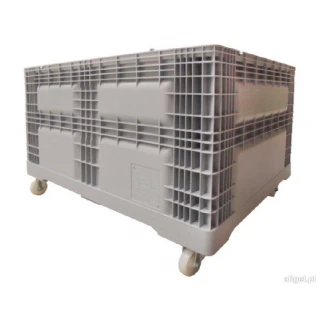
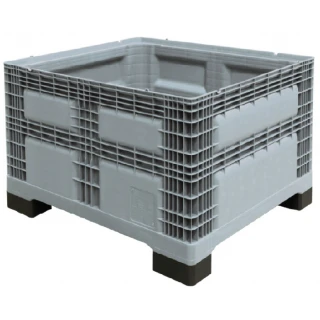
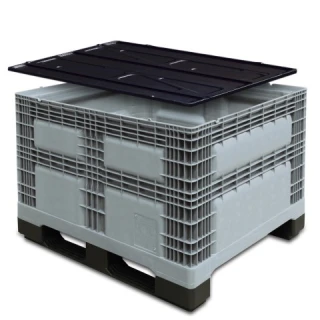
We can distinguish between several different bases for plastic crates. The lightest and cheapest of them are the boxes on feet. This option is chosen by customers who do not stack their containers (although boxes on feet can also be stacked), do not use it on a tipper to dump the goods inside, and do not move them from place to place too often. Another basis is three or two skids. Pallet-containers with the size of the Euro pallet base, that is, 120x80 cm, only come in the two skids variant. Larger containers (standard) with a base dimension of 120x100 cm are also available on three skids. Such a box pallet is best suited for warehouses where the containers are heavily used. The last type of available bases are box pallets on wheels, which provide it with very good mobility, they are most often used in small warehouses or on production halls, where forklift operation is difficult due to lack of space.
 
 
Openwork or full, smooth walls?
Large-size containers are available in two variants of wall and bottom forms.
 
Openwork box pallets with the so-called ventilation holes are dedicated primarily to the orchard industry, and prove useful for transporting and storing fruits and vegetables. And box pallets with a bottom and smooth walls are widely used in the machinery industry, logistics, printing, clothing, wood and metal industries.


Are box pallets approved for food contact?
Plastic crates are manufactured from two types of material. The first is polypropylene, which is approved for food contact, while the second type of material is re-granulate, or recycled material, which is not approved. Both materials have very similar resistance to acids or chemicals.


Can a drain tap be installed?
Boxes do not have a drain tap installed, but they do have places where such a tap can be installed. Such places are found in containers with smooth walls on the long side and on the short side. They are used in industry, where liquid material is transported in a box pallet, additionally protected during transport by a dedicated lid.


External ribbing or is it standard?
External ribbing is intended to make the boxes more durable for transport and, above all, for stacking.
Gallery
 skrzyniopalety_plastikowe  pojemniki_plastik  kisten

Other articles

  • Plastic parking grid KP4G 60 x 39.5 cm, load capacity 350 t/m²
    24-11-2026

    Which parking grid should you choose? Load capacity, dimensions and pieces per m²: table

    A parking grid is chosen primarily by the load it has to carry: for foot traffic and gardens, grids with a load capacity of approx. 150 t/m² (2.5–3 cm high) are sufficient; for driveways and car parks for passenger cars – 250–350 t/m² (4 cm high); for heavy traffic and the highest axle loads – 450 t/m² grids or 5 cm high models. Depending on the format, you need 2 to 7 grids per m² – the most popular 50 × 50 cm format means 4 pieces per m².

  • Plastic H1 pallet 120x80: pallet weight 18 kg
    17-11-2026

    How much does a pallet weigh? Euro, plastic and H1 pallet weights: table

    A wooden EPAL Euro pallet measuring 1200 × 800 mm weighs approximately 25 kg. A plastic pallet of the same size weighs, depending on its design, from approx. 4.5 kg (a lightweight open-deck export pallet) to approx. 20 kg (closed-deck, reinforced). A hygienic H1 pallet 120 × 80 weighs 18 kg, and 120 × 100 plastic pallets weigh from approx. 6.5 to 23 kg.

  • IBC heating jacket – 1000 l IBC container protected against frost
    10-11-2026

    IBC tank in winter: how to protect an IBC container from frost

    In winter, an IBC tank (1000 l IBC tote) must above all be protected against its contents freezing – water expands by about 9% when it turns to ice, which can crack the drain valve and damage the bottle. An IBC used for rainwater is best emptied before the frosts. An IBC holding process liquids should be stored in a heated building or wrapped in a thermal insulation jacket and – at sub-zero temperatures – a heating jacket with a thermostat.