
Collapsible or rigid box pallet? When it pays off
Published on: 04-06-2026
Collapsible vs rigid — comparison
| Criterion | Collapsible | Rigid |
|---|---|---|
| Empty volume | −70% when folded | full (takes space) |
| Stiffness / capacity | high | maximum |
| Return transport | cheap (more per truck) | costly |
| Mechanism durability | hinges/latches | no moving parts |
When collapsible pays off
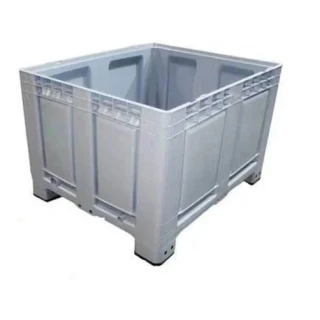
When pallets return empty (closed loop with a supplier, export, rental), savings on transport and warehouse space quickly outweigh the price difference. Example: a trailer fits several times more folded box pallets than rigid ones — fewer trips, lower return-logistics cost.
When rigid is better
For very heavy, sharp or hot loads, and where the box pallet circulates mainly inside the plant and rarely returns empty — no folding mechanism means greater strength and fewer parts to service.
Selection by size and walls
| Parameter | Tip |
|---|---|
| Size | 1200×800 (EUR) or 1200×1000 (industrial) — for pallet and rack |
| Walls | solid (hygiene, small parts) or perforated (ventilation, lighter) |
| Capacity | check dynamic load and stacking |
Related products
See plastic box pallets, plastic pallets and plastic containers. Manufacturer Paleteo, shipped from Poland.
FAQ
How much space does a collapsible box pallet save? Folded it takes about 70% less volume than when erected.
Is collapsible weaker than rigid? It has high capacity, but rigid offers maximum stiffness and no moving parts.
Which for export? Usually collapsible — lower transport and empty-storage cost.
Other articles
-

24-11-2026 Which parking grid should you choose? Load capacity, dimensions and pieces per m²: table
A parking grid is chosen primarily by the load it has to carry: for foot traffic and gardens, grids with a load capacity of approx. 150 t/m² (2.5–3 cm high) are sufficient; for driveways and car parks for passenger cars – 250–350 t/m² (4 cm high); for heavy traffic and the highest axle loads – 450 t/m² grids or 5 cm high models. Depending on the format, you need 2 to 7 grids per m² – the most popular 50 × 50 cm format means 4 pieces per m².
-

17-11-2026 How much does a pallet weigh? Euro, plastic and H1 pallet weights: table
A wooden EPAL Euro pallet measuring 1200 × 800 mm weighs approximately 25 kg. A plastic pallet of the same size weighs, depending on its design, from approx. 4.5 kg (a lightweight open-deck export pallet) to approx. 20 kg (closed-deck, reinforced). A hygienic H1 pallet 120 × 80 weighs 18 kg, and 120 × 100 plastic pallets weigh from approx. 6.5 to 23 kg.
-

10-11-2026 IBC tank in winter: how to protect an IBC container from frost
In winter, an IBC tank (1000 l IBC tote) must above all be protected against its contents freezing – water expands by about 9% when it turns to ice, which can crack the drain valve and damage the bottle. An IBC used for rainwater is best emptied before the frosts. An IBC holding process liquids should be stored in a heated building or wrapped in a thermal insulation jacket and – at sub-zero temperatures – a heating jacket with a thermostat.