PALETEO.com | Warehouse equipment

Categories

IBC container sizes and capacities

Published on: 24-06-2025

The most popular size is 1,000 litres, ideal for industrial needs where large quantities of liquids need to be stored. However, there are also smaller models with capacities of:
  • 600 litres,
  • 300 litres.
These compact variants are indispensable in places with limited space or when smaller quantities of substances are transported.

IBC containers are used in various sectors, such as:

  • food,
  • chemical,
  • pharmaceutical.
They provide the necessary flexibility and functionality for effective logistics management and liquid storage.
Available capacities: 1000, 600, 300 litres

IBC containers are available in various capacities:

  • 1000 litres,
  • 600 litres,
  • 300 litres.
This range of sizes allows for flexible adaptation to specific logistics and storage requirements. The choice of the appropriate size depends on the quantity of the substance to be stored and the available space. Large 1000 litre containers are ideal for industrial applications where large quantities of liquids need to be stored. Smaller variants, such as those with a capacity of 300 litres, are ideal where space is limited or when dealing with smaller batches of material.

Customised containers: individual customer needs

The production of containers tailored to individual customer needs enables the optimisation of logistics and warehouse management. This flexibility allows the dimensions, materials and functions of the containers to be modified in accordance with the unique requirements of different industries.
  • In the chemical industry, corrosion-resistant materials such as stainless steel are often used.
  • In the food sector, hygiene and ease of cleaning are key.
The customisation of IBC containers contributes to more efficient use of space both in warehouses and during transport. The production process takes into account the specific needs related to the storage and transport of various substances, which translates into greater safety and environmental protection. This allows companies to reduce operating costs and minimise losses resulting from improper storage or transport of goods.

The customisation of containers supports better management of company resources, which strengthens its competitive position in the market. This approach not only provides more functional storage solutions, but also integration with the customer's existing logistics systems, significantly increasing the efficiency of the entire supply chain.

Standard pallets: compatibility with dimensions 1200×1200 and 1200×800
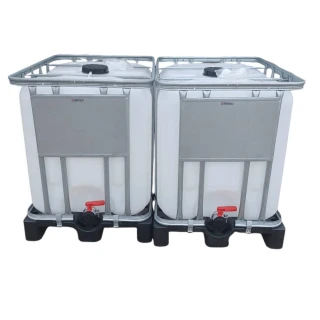
Standard pallets with dimensions of 1200×1200 mm and 1200×800 mm are extremely popular in logistics. Their versatility, especially in the context of IBC containers, significantly improves the transport and storage of goods. This makes handling and storage using forklifts easier. The compatibility of these sizes is key to optimising logistics processes, allowing for the effective use of space both in warehouses and during transport.
Gallery
 kontenery_IBC

Other articles

  • Plastic parking grid KP4G 60 x 39.5 cm, load capacity 350 t/m²
    24-11-2026

    Which parking grid should you choose? Load capacity, dimensions and pieces per m²: table

    A parking grid is chosen primarily by the load it has to carry: for foot traffic and gardens, grids with a load capacity of approx. 150 t/m² (2.5–3 cm high) are sufficient; for driveways and car parks for passenger cars – 250–350 t/m² (4 cm high); for heavy traffic and the highest axle loads – 450 t/m² grids or 5 cm high models. Depending on the format, you need 2 to 7 grids per m² – the most popular 50 × 50 cm format means 4 pieces per m².

  • Plastic H1 pallet 120x80: pallet weight 18 kg
    17-11-2026

    How much does a pallet weigh? Euro, plastic and H1 pallet weights: table

    A wooden EPAL Euro pallet measuring 1200 × 800 mm weighs approximately 25 kg. A plastic pallet of the same size weighs, depending on its design, from approx. 4.5 kg (a lightweight open-deck export pallet) to approx. 20 kg (closed-deck, reinforced). A hygienic H1 pallet 120 × 80 weighs 18 kg, and 120 × 100 plastic pallets weigh from approx. 6.5 to 23 kg.

  • IBC heating jacket – 1000 l IBC container protected against frost
    10-11-2026

    IBC tank in winter: how to protect an IBC container from frost

    In winter, an IBC tank (1000 l IBC tote) must above all be protected against its contents freezing – water expands by about 9% when it turns to ice, which can crack the drain valve and damage the bottle. An IBC used for rainwater is best emptied before the frosts. An IBC holding process liquids should be stored in a heated building or wrapped in a thermal insulation jacket and – at sub-zero temperatures – a heating jacket with a thermostat.

