PALETEO.com | Warehouse equipment

Categories

Self-unloading containers – applications, types and practical advantages

Published on: 17-06-2025

How do self-unloading containers work?

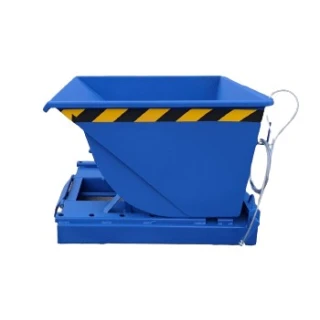
Self-unloading containers use a variety of mechanisms for automatic emptying:
  • a tilting mechanism allows for quick unloading by tilting the container, which is particularly useful when transporting large quantities of loose materials,
  • an opening bottom mechanism works by opening the bottom of the container, allowing the contents to be discharged directly,
  • automated unloading systems use modern technologies to precisely and effectively control the unloading process.
Thanks to these solutions, containers of this type are widely used in industries that require fast transport and efficient unloading of goods. Their design minimises the need for additional equipment during emptying, which significantly increases work efficiency. As a result, the time needed for logistics operations is reduced and transport costs are lowered.

Tilting mechanism

The tilting mechanism in self-unloading containers works by tilting them, which allows for instant emptying of the contents. This is crucial for the efficient transport of large quantities of bulk materials such as:
  • sand,
  • grains,
  • other bulk materials.
This system enables quick unloading without the need for additional equipment, which translates into savings in time and logistics costs. In addition, this approach increases operational efficiency in many industries where intensive material flow is important.

Opening bottom mechanism

The bottom opening mechanism in self-unloading containers allows for instant emptying of the contents by opening the lower part. This makes the unloading process much faster, which is key to saving time and increasing work efficiency. This system allows for direct discharge of materials, eliminating the need for additional equipment. This is particularly valuable in industries where intensive material flow and fast loading and unloading are a priority.

Automated unloading system

The automatic unloading system increases transport efficiency by working in harmony with other equipment. This makes unloading operations faster and more precise. This is crucial for sectors that need to move large quantities of goods quickly. Automation reduces the need for manual labour, minimising the risk of errors and reducing costs. What is more, modern technologies in these systems streamline logistics processes and optimise resource utilisation, contributing to an increase in overall efficiency.

Construction and features of self-unloading containers

Self-unloading containers are distinguished by their durability and robustness. Thanks to 2 mm thick metal sheets, they are suitable for everyday use and resistant to damage even in difficult working conditions, which ensures their long service life without concerns about their technical condition.

Another advantage is their exceptional resistance to all weather conditions. Regardless of rain or snow, these containers work well both indoors and outdoors. For those who need reliability regardless of the weather, they are the ideal solution.

In addition, they can be equipped with chains for attachment to forklifts. This significantly facilitates transport and increases safety in logistics. Their robust construction and adaptability make these containers an excellent choice for industry and agriculture.

Durable construction

The design of self-unloading containers must be robust to ensure durability and protect against damage. The use of top-quality materials, such as thick sheet metal, makes them suitable for transport even in demanding conditions. We can be confident about their technical condition. Their strong construction protects the transported goods, minimising the risk of damage. As a result, these containers perfectly meet the needs of the logistics industry, offering reliability even in the most difficult operating situations.

Adaptation to weather conditions

Self-unloading containers are ideal for a variety of weather conditions. Thanks to their solid construction, they effectively protect the contents from rain, snow and wind, making them ideal for use both indoors and outdoors. Their resistance to changing climatic conditions ensures that they remain reliable for a long time. This is a great solution for industries that need to operate continuously regardless of the weather.

See also in our shop: Self-tipping containers (tipping skips) · Plastic box pallets
Gallery
 koleba-budowlana

Other articles

  • Plastic parking grid KP4G 60 x 39.5 cm, load capacity 350 t/m²
    24-11-2026

    Which parking grid should you choose? Load capacity, dimensions and pieces per m²: table

    A parking grid is chosen primarily by the load it has to carry: for foot traffic and gardens, grids with a load capacity of approx. 150 t/m² (2.5–3 cm high) are sufficient; for driveways and car parks for passenger cars – 250–350 t/m² (4 cm high); for heavy traffic and the highest axle loads – 450 t/m² grids or 5 cm high models. Depending on the format, you need 2 to 7 grids per m² – the most popular 50 × 50 cm format means 4 pieces per m².

  • Plastic H1 pallet 120x80: pallet weight 18 kg
    17-11-2026

    How much does a pallet weigh? Euro, plastic and H1 pallet weights: table

    A wooden EPAL Euro pallet measuring 1200 × 800 mm weighs approximately 25 kg. A plastic pallet of the same size weighs, depending on its design, from approx. 4.5 kg (a lightweight open-deck export pallet) to approx. 20 kg (closed-deck, reinforced). A hygienic H1 pallet 120 × 80 weighs 18 kg, and 120 × 100 plastic pallets weigh from approx. 6.5 to 23 kg.

  • IBC heating jacket – 1000 l IBC container protected against frost
    10-11-2026

    IBC tank in winter: how to protect an IBC container from frost

    In winter, an IBC tank (1000 l IBC tote) must above all be protected against its contents freezing – water expands by about 9% when it turns to ice, which can crack the drain valve and damage the bottle. An IBC used for rainwater is best emptied before the frosts. An IBC holding process liquids should be stored in a heated building or wrapped in a thermal insulation jacket and – at sub-zero temperatures – a heating jacket with a thermostat.

