PALETEO.com | Warehouse equipment

Categories

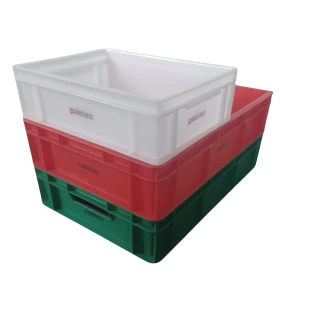
Applications of plastic containers in the B2B sector

Published on: 26-05-2025

In the food industry, plastic containers help to preserve the freshness of products thanks to their airtight closures, which is essential for food safety. In the chemical sector, they ensure the safe storage of substances, protecting against spills and contamination. In retail, on the other hand, they support the organisation of shops and the transport of items.

Thanks to their versatility, plastic containers are also ideal for organising workplaces. They make it possible to keep things tidy by segregating tools and materials used on a daily basis. They are also indispensable in logistics, where standards such as Euronorms streamline storage and distribution processes.

Companies seeking to optimise logistics and production will find a valuable ally in these containers. Their diversity allows them to adapt to the specific requirements of different industries, becoming an essential element of the B2B segment's resource management strategy.

Storage and transport

Plastic containers play a key role in storage and transport. Thanks to their durability and the wide range of sizes available, they are used in many industries. Their resistance to damage makes them ideal for storing products in sectors such as:
  • food,
  • automotive,
  • logistics.
In the food industry, they effectively protect food from moisture and contamination, which helps to keep food fresher for longer. In logistics, on the other hand, they contribute to better organisation of storage space, allowing for easy stacking and fitting into standard transport systems.

The various sizes and shapes of these containers enable efficient use of warehouse space. This is extremely important for companies seeking to optimise their logistics processes.

Workstation organisation

The use of plastic containers in the organisation of workplaces has many benefits:
  • they allow more efficient management of tools and materials,
  • they make segregation much easier,
  • available in a variety of sizes and shapes, they offer a wide range of application options,
  • the clever arrangement of items increases efficiency,
  • everyday work becomes simpler.
In addition, the right choice of containers helps to maintain order, which significantly increases comfort and safety at work.

Food, chemical and retail industries

Plastic containers have an important function in the food, chemical and retail sectors. They enable the safe storage and transport of a wide variety of goods.
  • In the food industry, they protect foodstuffs from moisture and undesirable substances, thus preventing contamination,
  • thanks to their tight closures, products remain fresh for longer, which is extremely important for their storage.
For the chemical sector, the containers must be robust to prevent leakage of materials. The robust construction ensures resistance to aggressive chemicals, which increases safety when transporting and storing these materials.

In retail, the containers support the organisation of the shop space and facilitate the management of resources. The availability of different sizes allows them to be adapted to the individual requirements of each industry, which optimises logistics and production processes. Their versatility makes them indispensable tools in the daily operations of B2B companies.

Agriculture and horticulture

Plastic containers play a key role in agriculture and horticulture thanks to their versatility and durability. They are used for both storing and transporting crops, and are invaluable for planting, significantly increasing the efficiency of these operations. The robust containers, available in a variety of sizes, make better use of cultivation space.

Their resistance to changing weather conditions protects the contents from dampness or mechanical damage, which is extremely important for preserving the quality and freshness of the harvest. Planting containers facilitate the planting process by allowing the root system of young plants to develop in a controlled manner. They allow the seedlings to be moved safely, minimising the risk of damage, which speeds up production in nurseries and on garden farms.
 
Gallery
 pojemniki_plastikowe

Other articles

  • Plastic parking grid KP4G 60 x 39.5 cm, load capacity 350 t/m²
    24-11-2026

    Which parking grid should you choose? Load capacity, dimensions and pieces per m²: table

    A parking grid is chosen primarily by the load it has to carry: for foot traffic and gardens, grids with a load capacity of approx. 150 t/m² (2.5–3 cm high) are sufficient; for driveways and car parks for passenger cars – 250–350 t/m² (4 cm high); for heavy traffic and the highest axle loads – 450 t/m² grids or 5 cm high models. Depending on the format, you need 2 to 7 grids per m² – the most popular 50 × 50 cm format means 4 pieces per m².

  • Plastic H1 pallet 120x80: pallet weight 18 kg
    17-11-2026

    How much does a pallet weigh? Euro, plastic and H1 pallet weights: table

    A wooden EPAL Euro pallet measuring 1200 × 800 mm weighs approximately 25 kg. A plastic pallet of the same size weighs, depending on its design, from approx. 4.5 kg (a lightweight open-deck export pallet) to approx. 20 kg (closed-deck, reinforced). A hygienic H1 pallet 120 × 80 weighs 18 kg, and 120 × 100 plastic pallets weigh from approx. 6.5 to 23 kg.

  • IBC heating jacket – 1000 l IBC container protected against frost
    10-11-2026

    IBC tank in winter: how to protect an IBC container from frost

    In winter, an IBC tank (1000 l IBC tote) must above all be protected against its contents freezing – water expands by about 9% when it turns to ice, which can crack the drain valve and damage the bottle. An IBC used for rainwater is best emptied before the frosts. An IBC holding process liquids should be stored in a heated building or wrapped in a thermal insulation jacket and – at sub-zero temperatures – a heating jacket with a thermostat.