
Plastic Pallet Boxes and Plastic Containers for the Fish Industry
Published on: 26-03-2020
Storage and transportation for the needs of various industries, is becoming an important part of their operation, so much importance is placed on the appropriate functionality of individual pallets
Ideal for food industries
Pallets made of plastic are now displacing wooden pallets. They are more durable than them, more practical, as well as easier to clean. Hence they are so often used precisely by food industries, such as the fishing industry. Their biggest advantage is that they can be cleaned thoroughly, and importantly, thanks to the special design of the individual pallets, their flat surface without furrows, dirt does not stick to the plastic. Thus, all of them have the necessary certificates and meet all the quality standards required by the sanitary authorities. Importantly, the pallets are resistant to environmental factors, such as high temperature, viscosity, acidity, chemical resistance. This is extremely important in the fish industry. Fish products must be stored and transported in hygienic conditions, so that the proliferation of bacteria and unwanted contaminants is almost reduced to a minimum.
Functionality of plastic pallets
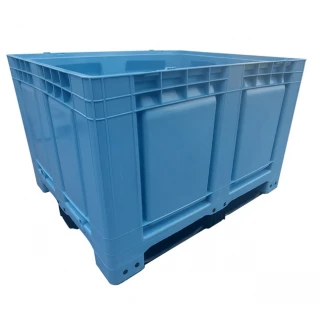
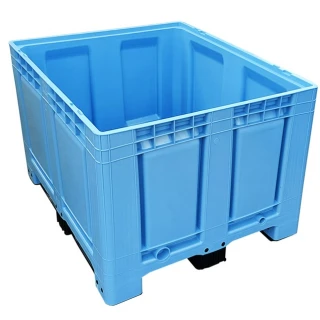
A wide range of plastic box pallets includes both boxes with skids and pallets set only on feet. Folding pallets are also available to customers, thanks to which it is possible to reduce storage space when temporarily deprived of cargo. Such folding pallet boxes are easier to transport. Many crates are available with additional equipment, such as a drain valve or a dedicated lid. Thanks to these elements, it is possible to take care of almost perfect cleanliness and sterility of the containers. An additional advantage is the smoothness of the inner walls, where dirt and other contaminants do not stick, which is particularly important in the fish industry, where neutralization of odors is a priority.
Plastic displaces wooden
The better efficiency of plastic pallets is certainly evidenced by their high resistance to damage. The strength of box pallets means that they have already almost completely displaced wooden pallets, which when damaged lost their stability and their structure was destabilized. This is also mentioned by the expert of paleteo.pl: "Plastic pallets are an excellent alternative to wooden pallets, as they have a stable and durable structure, and have a long service life of up to 10-15 years. Comparing them with wooden pallets, they win in several areas, they have a low weight, characterized by high resistance to damage, the effects of temperature chemicals, and adverse weather conditions. "It is worth noting that the material from which pallets are made for contact with food products is HDPE granulate, which is tasteless, odorless and completely non-toxic. Thus, box pallets are high quality and, above all, an investment that quickly pays for itself.
.
See also in our shop: Plastic box pallets · Plastic containers
Other articles
-

24-11-2026 Which parking grid should you choose? Load capacity, dimensions and pieces per m²: table
A parking grid is chosen primarily by the load it has to carry: for foot traffic and gardens, grids with a load capacity of approx. 150 t/m² (2.5–3 cm high) are sufficient; for driveways and car parks for passenger cars – 250–350 t/m² (4 cm high); for heavy traffic and the highest axle loads – 450 t/m² grids or 5 cm high models. Depending on the format, you need 2 to 7 grids per m² – the most popular 50 × 50 cm format means 4 pieces per m².
-

17-11-2026 How much does a pallet weigh? Euro, plastic and H1 pallet weights: table
A wooden EPAL Euro pallet measuring 1200 × 800 mm weighs approximately 25 kg. A plastic pallet of the same size weighs, depending on its design, from approx. 4.5 kg (a lightweight open-deck export pallet) to approx. 20 kg (closed-deck, reinforced). A hygienic H1 pallet 120 × 80 weighs 18 kg, and 120 × 100 plastic pallets weigh from approx. 6.5 to 23 kg.
-

10-11-2026 IBC tank in winter: how to protect an IBC container from frost
In winter, an IBC tank (1000 l IBC tote) must above all be protected against its contents freezing – water expands by about 9% when it turns to ice, which can crack the drain valve and damage the bottle. An IBC used for rainwater is best emptied before the frosts. An IBC holding process liquids should be stored in a heated building or wrapped in a thermal insulation jacket and – at sub-zero temperatures – a heating jacket with a thermostat.