PALETEO.com | Warehouse equipment

Categories

The use of plastic pallets in various sectors

Published on: 10-09-2024

Food and pharmaceutical industry
Plastic pallets play a key role in the food and pharmaceutical industries. Due to their ease of cleaning, they minimise the risk of contamination, which is important in both these sectors. In addition, plastic does not absorb moisture, odours or chemicals, making it ideal for environments where hygiene is a priority.

In pharmacy, as in the food industry, safety and hygiene are extremely important. Plastic pallets meet the high standards required in these industries, enabling the safe transport of medicines and other pharmaceutical products.

Chemical industry
In the chemical industry, plastic pallets are of particular importance. They are resistant to a wide range of chemicals such as acids, bases and solvents, making them ideal for storing, processing and transporting such products. Unlike wooden pallets, which can deteriorate when exposed to chemicals, plastic pallets retain their strength and reliability under harsh conditions.

An additional advantage of plastic pallets is their resistance to moisture, which is important when dealing with hygroscopic chemicals that absorb water. Plastic pallets help prevent such substances from coming into contact with moisture, protecting against corrosion and loss of product quality.

Electronics industry
The electronics industry is increasingly using plastic pallets, especially those made of anti-static materials, to protect delicate electronic components during transport and storage.

Logistics and transport industry
In logistics and transport, plastic pallets are valued for their light weight and simultaneous strength, allowing heavy loads to be transported. Their design allows them to fit easily into standard spaces in warehouses and transport vehicles, optimising space.

Plastic pallets are also safer for workers - they do not have protruding nails or cause splinters, which is a common problem with wooden pallets. This is particularly important in environments where workers may be exposed to additional hazards, such as contact with hazardous chemicals.

See also in our shop: Plastic pallets · Plastic box pallets
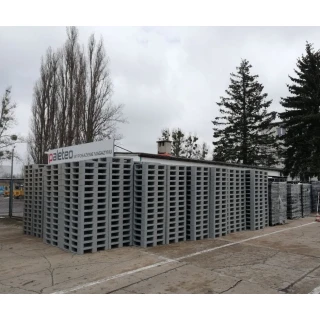
Gallery
 palety-plastikowe

Other articles

  • Plastic parking grid KP4G 60 x 39.5 cm, load capacity 350 t/m²
    24-11-2026

    Which parking grid should you choose? Load capacity, dimensions and pieces per m²: table

    A parking grid is chosen primarily by the load it has to carry: for foot traffic and gardens, grids with a load capacity of approx. 150 t/m² (2.5–3 cm high) are sufficient; for driveways and car parks for passenger cars – 250–350 t/m² (4 cm high); for heavy traffic and the highest axle loads – 450 t/m² grids or 5 cm high models. Depending on the format, you need 2 to 7 grids per m² – the most popular 50 × 50 cm format means 4 pieces per m².

  • Plastic H1 pallet 120x80: pallet weight 18 kg
    17-11-2026

    How much does a pallet weigh? Euro, plastic and H1 pallet weights: table

    A wooden EPAL Euro pallet measuring 1200 × 800 mm weighs approximately 25 kg. A plastic pallet of the same size weighs, depending on its design, from approx. 4.5 kg (a lightweight open-deck export pallet) to approx. 20 kg (closed-deck, reinforced). A hygienic H1 pallet 120 × 80 weighs 18 kg, and 120 × 100 plastic pallets weigh from approx. 6.5 to 23 kg.

  • IBC heating jacket – 1000 l IBC container protected against frost
    10-11-2026

    IBC tank in winter: how to protect an IBC container from frost

    In winter, an IBC tank (1000 l IBC tote) must above all be protected against its contents freezing – water expands by about 9% when it turns to ice, which can crack the drain valve and damage the bottle. An IBC used for rainwater is best emptied before the frosts. An IBC holding process liquids should be stored in a heated building or wrapped in a thermal insulation jacket and – at sub-zero temperatures – a heating jacket with a thermostat.

