PALETEO.com | Warehouse equipment

Categories

Warehouse equipment - hygienic pallets and plastic crates

Published on: 03-09-2024

Plastic pallets - a solid and hygienic base
Plastic pallets are one of the most commonly used items of warehouse equipment. They are not only durable, but also resistant to moisture, chemicals and changeable weather conditions. For this reason, they are ideal for industries where hygiene is important, such as the food and pharmaceutical industries.
Among the different types of pallets, special attention should be paid to hygienic pallets. They are designed to meet high sanitary standards, making them ideal for storing and transporting food products.
Pallet 1200x800 and pallet 80x60 - standard sizes
In warehouses, standard pallet sizes are extremely important as they facilitate space organisation and efficient use of space. The most popular size in Europe is the 1200x800 mm pallet, also known as the Euro pallet. This is a universal size that fits perfectly into most racking systems and transport vehicles.
The second popular size is the 80x60 cm half pallet. These smaller pallets are ideal for applications where more flexibility is needed, such as retail shops or small warehouses. Half-pallets also facilitate quick access to goods, which is key in fast-selling logistics.
Plastic crates and boxes - storage versatility
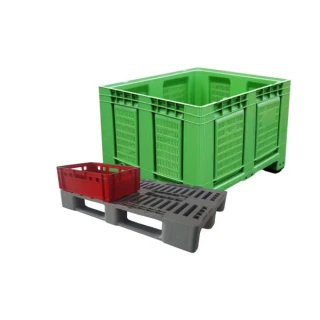
Plastic crates are another key solution for warehouses. They combine the advantages of pallets and crates, offering a large capacity for storing larger quantities of goods. Thanks to their robust construction and resistance to mechanical damage, plastic crates and boxes are ideal for storing heavier products.
For the food industry, vegetable crates are particularly useful. These types of crates are lightweight, easy to clean and ventilated, which ensures adequate air circulation and protects vegetables from spoiling.
Kisten - the solution for larger quantities
When storing large quantities of produce, it is worth considering a kisten. Kisten, which are large, sturdy boxes made of plastic, are the ideal solution for storing and transporting large batches of goods. They are often used in agriculture, the food industry and other industries where storage efficiency and safety are key.
 
Effective warehouse management requires the right equipment. Plastic pallets, the 80x60 pallet, the 1200x800 pallet, half pallets, plastic crates and boxes, vegetable crates and kisten are all items that not only make everyday work easier, but also increase the operational efficiency of the warehouse. Choosing the right solutions depends on the specifics of your business, but investing in modern and durable equipment always brings benefits in the form of better organisation and time and cost savings.

See also in our shop: Plastic pallets · Plastic box pallets
Gallery
 palety-plastikowe

Other articles

  • Plastic parking grid KP4G 60 x 39.5 cm, load capacity 350 t/m²
    24-11-2026

    Which parking grid should you choose? Load capacity, dimensions and pieces per m²: table

    A parking grid is chosen primarily by the load it has to carry: for foot traffic and gardens, grids with a load capacity of approx. 150 t/m² (2.5–3 cm high) are sufficient; for driveways and car parks for passenger cars – 250–350 t/m² (4 cm high); for heavy traffic and the highest axle loads – 450 t/m² grids or 5 cm high models. Depending on the format, you need 2 to 7 grids per m² – the most popular 50 × 50 cm format means 4 pieces per m².

  • Plastic H1 pallet 120x80: pallet weight 18 kg
    17-11-2026

    How much does a pallet weigh? Euro, plastic and H1 pallet weights: table

    A wooden EPAL Euro pallet measuring 1200 × 800 mm weighs approximately 25 kg. A plastic pallet of the same size weighs, depending on its design, from approx. 4.5 kg (a lightweight open-deck export pallet) to approx. 20 kg (closed-deck, reinforced). A hygienic H1 pallet 120 × 80 weighs 18 kg, and 120 × 100 plastic pallets weigh from approx. 6.5 to 23 kg.

  • IBC heating jacket – 1000 l IBC container protected against frost
    10-11-2026

    IBC tank in winter: how to protect an IBC container from frost

    In winter, an IBC tank (1000 l IBC tote) must above all be protected against its contents freezing – water expands by about 9% when it turns to ice, which can crack the drain valve and damage the bottle. An IBC used for rainwater is best emptied before the frosts. An IBC holding process liquids should be stored in a heated building or wrapped in a thermal insulation jacket and – at sub-zero temperatures – a heating jacket with a thermostat.

