
KLT containers: types (R-KLT, RL-KLT), dimensions and how to choose
Published on: 11-07-2024
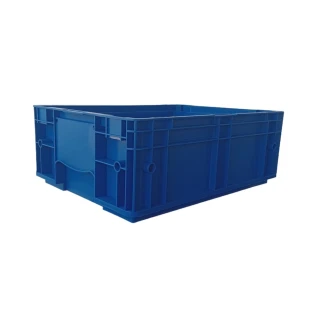
A KLT container (German: Kleinladungsträger, small load carrier) is a standardised polypropylene container for transporting and storing parts, described in the automotive recommendation VDA 4500. It comes in modular sizes of 300 × 200, 400 × 300 and 600 × 400 mm, so the containers fill a 1200 × 800 or 1200 × 1000 mm pallet with no wasted space. PALETEO KLT containers have a capacity from 5.3 to approx. 60 l and a load capacity of up to 20 kg.
R-KLT, RL-KLT, foldable and ESD – the differences
- R-KLT has a rigid, ribbed composite base. It is heavier and stiffer, which makes it suitable for conveyors and automated warehouses.
- RL-KLT is the lighter version with a smooth base. At the same size it weighs less and holds slightly more: the 600 × 400 × 280 mm model weighs approx. 2.7 kg and holds approx. 52 l, while the R-KLT weighs approx. 3 kg and holds 48 l.
- Foldable KLT containers fold flat when empty (model PKLTF64_28A is approx. 95 mm high when folded), which lowers the cost of return transport.
- ESD-KLT containers are made of a material that dissipates electrostatic charges and are used for transporting electronics.
Table: KLT containers – dimensions, capacity, weight
| Model | Type | External dimensions [mm] | Capacity | Weight | Load capacity |
|---|---|---|---|---|---|
| PA1 R-KLT | R-KLT | 300 × 200 × 150 | 5.3 l | approx. 0.6 kg | 20 kg |
| PA2 R-KLT | R-KLT | 400 × 300 × 150 | 10 l | approx. 1.3 kg | 20 kg |
| PA3 R-KLT | R-KLT | 400 × 300 × 280 | 22 l | approx. 1.8 kg | 20 kg |
| PA5 R-KLT | R-KLT | 600 × 400 × 280 | 48 l | approx. 3 kg | 20 kg |
| PA6 R-KLT | R-KLT | 1200 × 400 × 147 | 60.3 l | approx. 3.85 kg | – |
| PA2 RL-KLT | RL-KLT | 400 × 300 × 150 | approx. 12 l | approx. 1 kg | 20 kg |
| PA3 RL-KLT | RL-KLT | 400 × 300 × 280 | approx. 24 l | approx. 1.7 kg | 20 kg |
| PA5 RL-KLT | RL-KLT | 600 × 400 × 280 | approx. 52 l | approx. 2.7 kg | approx. 20 kg |
| PGKLTN64_28A | foldable | 600 × 400 × 280 | approx. 49 l | approx. 3 kg | approx. 25 kg |
| PKLTF64_28A | foldable | 600 × 400 × 280 | 46 l | approx. 3.5 kg | 20 kg |
Data from PALETEO product pages. Nominal dimensions; weight and capacity are approximate.
How many KLT containers fit on a pallet
KLT sizes are divisors of the pallet dimensions, so one layer covers the pallet completely:
| Container size [mm] | Pallet 1200 × 800 mm | Pallet 1200 × 1000 mm |
|---|---|---|
| 600 × 400 | 4 pcs | 5 pcs |
| 400 × 300 | 8 pcs | 10 pcs |
| 300 × 200 | 16 pcs | 20 pcs |
How to choose a KLT container – 4 steps
- Base size. Match the module to the part size and the pallet: 600 × 400, 400 × 300 or 300 × 200 mm.
- Height. 150 mm for small parts, 280 mm for larger ones; the taller the container, the fewer layers per pallet.
- Base type. R-KLT for automation and conveyors, RL-KLT where low weight and price matter.
- Circulation. If empty containers return to the supplier, consider a foldable model; for electronics choose the ESD version.
Frequently asked questions (FAQ)
What does KLT stand for?
KLT stands for the German Kleinladungsträger, meaning small load carrier. It is a standardised container for transporting parts, described in recommendation VDA 4500.
What is the difference between R-KLT and RL-KLT?
R-KLT has a rigid, ribbed composite base and is designed for automation. RL-KLT has a smooth base, is lighter and has slightly more capacity at the same external size.
What sizes do KLT containers come in?
The basic modules are 300 × 200, 400 × 300 and 600 × 400 mm, with a height of 150 or 280 mm. PALETEO also offers a 1200 × 400 × 147 mm model.
How much does a 600 × 400 × 280 mm KLT container weigh?
The rigid R-KLT weighs approx. 3 kg, the lighter RL-KLT approx. 2.7 kg, and foldable models approx. 3–3.5 kg.
How many 600 × 400 KLT containers fit on a Euro pallet?
One layer on a 1200 × 800 mm pallet holds 4 containers of 600 × 400 mm, and a 1200 × 1000 mm pallet holds 5.
Need a larger quantity or a transport quote? Add the containers to your quote request – we usually confirm price and lead time the same working day.
See in our shop: KLT containers, KLT 600 × 400, KLT 400 × 300. Looking for a 600 × 400 container outside the KLT standard? Read our guide to 600 × 400 containers.
Other articles
-

24-11-2026 Which parking grid should you choose? Load capacity, dimensions and pieces per m²: table
A parking grid is chosen primarily by the load it has to carry: for foot traffic and gardens, grids with a load capacity of approx. 150 t/m² (2.5–3 cm high) are sufficient; for driveways and car parks for passenger cars – 250–350 t/m² (4 cm high); for heavy traffic and the highest axle loads – 450 t/m² grids or 5 cm high models. Depending on the format, you need 2 to 7 grids per m² – the most popular 50 × 50 cm format means 4 pieces per m².
-

17-11-2026 How much does a pallet weigh? Euro, plastic and H1 pallet weights: table
A wooden EPAL Euro pallet measuring 1200 × 800 mm weighs approximately 25 kg. A plastic pallet of the same size weighs, depending on its design, from approx. 4.5 kg (a lightweight open-deck export pallet) to approx. 20 kg (closed-deck, reinforced). A hygienic H1 pallet 120 × 80 weighs 18 kg, and 120 × 100 plastic pallets weigh from approx. 6.5 to 23 kg.
-

10-11-2026 IBC tank in winter: how to protect an IBC container from frost
In winter, an IBC tank (1000 l IBC tote) must above all be protected against its contents freezing – water expands by about 9% when it turns to ice, which can crack the drain valve and damage the bottle. An IBC used for rainwater is best emptied before the frosts. An IBC holding process liquids should be stored in a heated building or wrapped in a thermal insulation jacket and – at sub-zero temperatures – a heating jacket with a thermostat.