PALETEO.com | Warehouse equipment

Categories

Benefits of Rainwater Harvesting

Published on: 19-03-2024

Rainwater harvesting, the practice of capturing rainwater and storing it for later use, is becoming increasingly popular for a number of important reasons.
1. water conservation
Water is a resource of fundamental importance to humanity. However, pollution and overuse have led to increasing problems with access to clean drinking water. Rainwater harvesting is a method of conserving water resources by taking full advantage of the natural phenomenon of precipitation.
2 Saving drinking water
Allocating rainwater to tasks that do not require it to be fully clean, such as watering the garden or flushing the toilet, saves a significant amount of potable water. In this way, the water remains available to the community for purposes where its high quality is essential.
3 Cost reduction
Rainwater harvesting can lead to financial savings. Despite the initial expense of installing rainwater harvesting systems, long-term savings in the cost of water used can be significant, especially for households and businesses.
4 Less strain on stormwater drains
Many stormwater drainage systems around the world face overloading, especially during storms and heavy rainfall. Rainwater harvesting helps reduce the amount of water that enters the sewer system, which can reduce the risk of flooding and infrastructure failure.
5 Sustainability
Rainwater harvesting is part of the drive for sustainable development, promoting the use of natural resources in a smart and environmentally friendly way. By implementing this practice, individuals and communities can co-create a more sustainable environment for future generations.

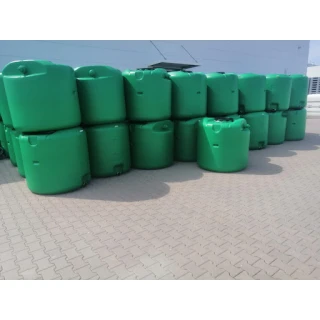
Rainwater tanks:
rainwater tanks
 

See also in our shop: Rainwater tanks · Industrial plastic tanks
Gallery
 zbiorniki_na_deszczówkę

Other articles

  • Plastic parking grid KP4G 60 x 39.5 cm, load capacity 350 t/m²
    24-11-2026

    Which parking grid should you choose? Load capacity, dimensions and pieces per m²: table

    A parking grid is chosen primarily by the load it has to carry: for foot traffic and gardens, grids with a load capacity of approx. 150 t/m² (2.5–3 cm high) are sufficient; for driveways and car parks for passenger cars – 250–350 t/m² (4 cm high); for heavy traffic and the highest axle loads – 450 t/m² grids or 5 cm high models. Depending on the format, you need 2 to 7 grids per m² – the most popular 50 × 50 cm format means 4 pieces per m².

  • Plastic H1 pallet 120x80: pallet weight 18 kg
    17-11-2026

    How much does a pallet weigh? Euro, plastic and H1 pallet weights: table

    A wooden EPAL Euro pallet measuring 1200 × 800 mm weighs approximately 25 kg. A plastic pallet of the same size weighs, depending on its design, from approx. 4.5 kg (a lightweight open-deck export pallet) to approx. 20 kg (closed-deck, reinforced). A hygienic H1 pallet 120 × 80 weighs 18 kg, and 120 × 100 plastic pallets weigh from approx. 6.5 to 23 kg.

  • IBC heating jacket – 1000 l IBC container protected against frost
    10-11-2026

    IBC tank in winter: how to protect an IBC container from frost

    In winter, an IBC tank (1000 l IBC tote) must above all be protected against its contents freezing – water expands by about 9% when it turns to ice, which can crack the drain valve and damage the bottle. An IBC used for rainwater is best emptied before the frosts. An IBC holding process liquids should be stored in a heated building or wrapped in a thermal insulation jacket and – at sub-zero temperatures – a heating jacket with a thermostat.

